| Author | Thread |
|
|
03/25/2009 04:30:22 AM · #1 |
I have been playing around recently taking macros of bugs with my 50mm 1.8 reversed on the end of my 28-105mm. I bought a cheap coupling ring on Ebay and it works great at short distances (ie less than an inch). My issue has been the DOF. I need to open the 50mm wide (to 1.8) in order to avoid ridiculously dramatic vignetting, and the depth of field is stupidly narrow.
I am always impressed with  Roz and others' bug macros, and I realise that they are very patient and have been perfecting their techniques over a long time, but I'm trying to work out what way to go with expanding my gear without being disappointed with the results. Roz and others' bug macros, and I realise that they are very patient and have been perfecting their techniques over a long time, but I'm trying to work out what way to go with expanding my gear without being disappointed with the results.
It seems that Roz uses a dedicated 100mm macro lens plus extension tubes for most of her macro work. I'm trying to work out if extension tubes in combination with my 28-105mm (which has a macro mode) will get anywhere even close, or if extension tubes with my 50mm might also be acceptable or if the 105mm Nikon macro without the extension tubes would suffice.
How much magnification would I get at what kind of focussing distance with the 105mm macro?
Am I going to be able to achieve a better DOF that what I have now with any of these options?
Help! |
|
|
|
03/25/2009 05:06:36 AM · #2 |
I'm not one to get all nerdy with stats, but I can show you examples. I have both the 50mm 1.8 and the Sigma 105mm. I also have the Kenko set of extension tubes that includes three sizes (12mm, 20mm, and 36mm). I've tried using all three at once before, but it's just been too hard to chase moving critters that close. I usually bump whatever they're sitting on and scare them, heh.
I know scale is hard to tell with my 50mm shots. Let me know if you have special requests.
50mm w/ 12mm extension tube
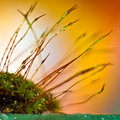
50mm w/ 20mm extension tube
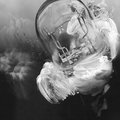
105mm w/ 20mm and 12mm extension tubes
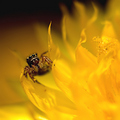  |
|
|
|
03/25/2009 05:16:32 AM · #3 |
That's an awesome help Michelle - you have the same camera and lens as I do!
OK - please excuse my ignorance - the 12mm gets you more magnification than the 20mm? I'm struggling to grasp the scale.
What about the 105mm on it's own? My guess is that you can focus a bit further away, but the magnification isn't as great? Am I right?
I'm guessing that the 105mm with the extension tubes is far superior to the 50mm with the extension tubes? Is it superior enough to warrant me paying more than $1,000 for a dedicated macro lens?
Both the Kenko extension tubes and macro lenses are expensive in Australian dollars, so I'm really trying to grasp what is my best option.
Thank you!! |
|
|
|
03/25/2009 05:34:13 AM · #4 |
Gah, this is hurting my brain already! heh
The 20mm should give you better magnification than the 12mm, and should allow you to get closer to the subject.
My examples aren't much good for showing the science behind what's going on. They're more to show capabilities I guess. It's a bit late tonight, but tomorrow I'll take some scientific shots with each of the lenses alone and then each coupled with some extension tubes. I'll most likely learn from the experience, so don't worry about it being a hassle.
=) |
|
|
|
03/25/2009 05:48:43 AM · #5 |
| Thank you!!!!! That would be so brilliant :) |
|
|
|
03/25/2009 04:11:17 PM · #6 |
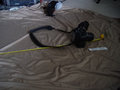
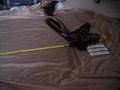
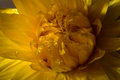
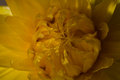
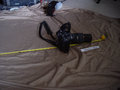
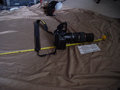
Well, that was fun... I made labels and everything!
I got as close as I could with each shot.
50mm / 50mm + 12mm Ext / 50mm + 36mm Ext / 50mm + 12mm + 20mm + 36mm Ext
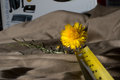  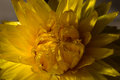 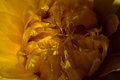
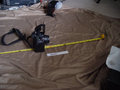 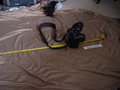  
105mm / 105mm + 12mm Ext / 105mm + 36mm Ext / 105mm + 12mm + 20mm + 36mm Ext
  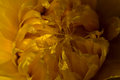 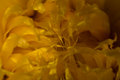
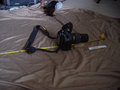 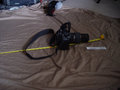   |
|
|
|
03/25/2009 04:41:06 PM · #7 |
To the OP:
When you use the 50mm reversed on the 28-105, you do always want the 50mm wide open. Control aperture with the 28-105. You want to shoot around f/11 to f/16 for the best combination of DoF and detail. Smaller apertures than f/16, (like f/22) will yield softer images because of diffraction. You might even see this at f/16, but it will be minimal.
Also, keep in mind that at a given magnification and aperture setting, your DoF will be the same, regardless of what lens (or lenses) you use to get there. The only complicating factor is that, with macro lenses, your actual aperture value may not be what you think it is, it may effectively be smaller. Depends on lens design |
|
|
|
03/25/2009 05:29:13 PM · #8 |
| Dedicated macro lens 105mm is your best bet. |
|
|
|
03/25/2009 06:04:40 PM · #9 |
Originally posted by kenskid:
Dedicated macro lens 105mm is your best bet. |
Or a 180mm. And maybe a nice ring flash. Also maybe macro focusing rails.
|
|
|
|
03/25/2009 06:33:23 PM · #10 |
Obviously not the best option, but this
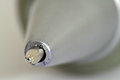
was taken with my Sigma 70-300mm f/4-5.6 DG Macro Telephoto Zoom Lens for Canon using a macro converter. I have used this setup for bugs too, but it gets a bit difficult when they more around too much. I don't know how much of that is my setup and how much is just that I'm not good at photographing bugs.
|
|
|
|
03/25/2009 09:27:38 PM · #11 |
| Thank you all for your help, and Michelle, you are an angel! I am at work at the moment, but I will read in detail tonight. |
|
Home -
Challenges -
Community -
League -
Photos -
Cameras -
Lenses -
Learn -
Help -
Terms of Use -
Privacy -
Top ^
DPChallenge, and website content and design, Copyright © 2001-2026 Challenging Technologies, LLC.
All digital photo copyrights belong to the photographers and may not be used without permission.
Current Server Time: 05/10/2026 08:31:22 PM EDT.