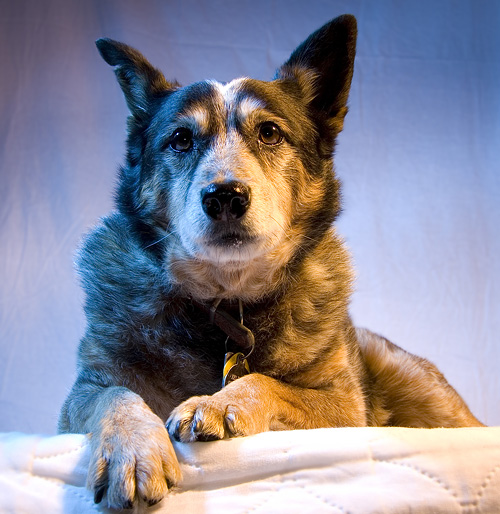
Hmm, Looks like a mixture of lighting sources here.
I would say a halogen or tungston light on the picture right, and a flash or sunlight left.
I'm not sure if the colour differences work here.
Also I don't like the creases in the background. This is easy to fix.
1. Iron it.
2. Get it further back & use a wider aperture to throw it out of focus
3. Use paper without creases in it.
Nice looking dog, and I like how you got down to its level. Good crop too.
The portrait of the dog is really nicely done, great pose and lighting - I'm not sure the surface and the background works though. I wonder if a wider open aperture which limited the depth of field to the face might have helped to hide the creased background?
The lighting on this pet portrait nicely illuminates the dog - love the sheen you see in some areas. The lighting also added some nice twinkle to the eyes. While the lighting is good it could be better. On the left hand side it sheds less light than the right half. But that does not bother me, what IS odd is that that light has more bluish tones while the more powerful lighting on the right has yellowish tones. Be careful in the choice of lightbulbs or lighting choices for some give off bluish tones while others cast more yellow tones. The result is what you see here, is that the dog has the left side with slightly bluish tones while the right has more yellow tones. The easiest solution is to make sure you use the same type of lighting for both sides. The solution to correct the exposure after the take is to play with color levels to play down the yellow tones so they are not as dominant or even play with sliding down the red hues to balance it more. The pose of the dog is good but the backdrop is not at all complementry. The white sheet in the backdrop shows folds and/or wrinkles which catch the light and shows shadows in the folds. Aside from ironing (which I dislike) and starching the darn sheet, you could easily bypass it by using a more shallow depth of field where the backdrop is blurred and the foreground subject is in focus. There are a few ways you could do this. One is move the sheet a few feet farther back such that when you focus on your main subject will have the backdrop more blurred. The other is that you adjust your camera focus specifically on one feature, let's say it is the eyes of the dog. Depending on your choice of aperture say 2.8 to 5.6 you will get some nice sharp details on the face and the backdrop will appear as a solid blurred 'wall' . The drawback however is that the paws will most likely be soft due to being further away from where you set your camera focus.





 Add photograph to your favorites
 Add photographer to your favorites


 Photographer found comment helpful.


