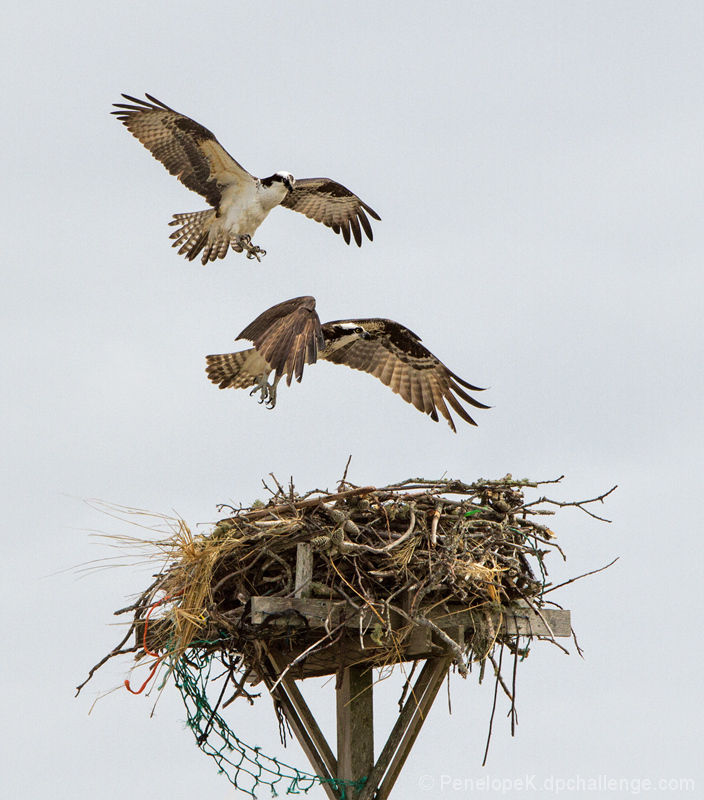
I've never seen a pair in flight near their nest before, let alone photographed a pair in that position, so I was pretty chuffed that I captured this. I assume it's early enough in the mating season that there are no eggs in the nest needing to be incubated yet, leaving both adults free to leave and look for food and nest re-building materials at the same time.
It was interesting to watch this pair approach and land on the nest. As they approached they were quite close to one another, with relatively flattened wings, then the slightly higher of the two started what I think of as a "braking/approach maneuver", creating more curve to his wings and starting to lower his feet and generally creating more air resistance in order to slow down, but kept in a position that provided protection to the other bird, who then slowed in a similar way and landed first.
I so wanted this to end up next to my image from earlier this year of a snowy owl sitting on an empty osprey's nest, but a last minute vote of 5 pushed it down a spot. Ah well, a lesson about attachment!
IMG_3142
Statistics
Place: 7 out of 96 Avg (all users): 6.7760 Avg (commenters): 7.7000 Avg (participants): 6.7600 Avg (non-participants): 6.7867 Views since voting: 1023 Views during voting: 268 Votes: 125 Comments: 14 Favorites: 0
I like the image and the moment of the birds caught in flight. Excellent photography apart from the very central crop and composition. However I am against the hand of man (the nest support) in any "Wildlife" imagery (although some crop it out of their images kudos that you didn’t. Whilst it may be argued that this is to aid their numbers by providing a nesting base where natural trees or roosts might have been eradicated and protect them from predators (and the birds are wild) it still is human intervention and belongs in a "Nature" category. True wildlife images are taken in the ever decreasing WILD.






 Add photograph to your favorites
 Add photographer to your favorites

 Photographer found comment helpful.


