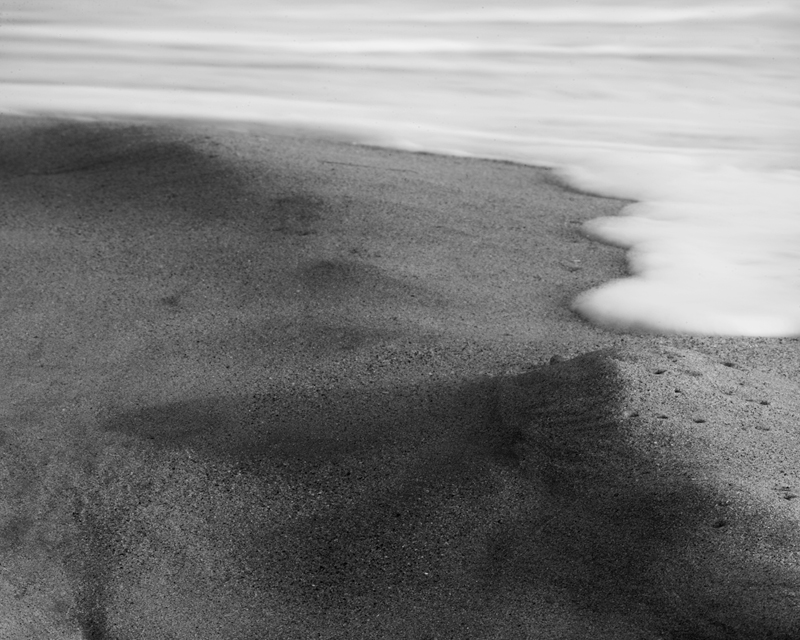
In Mandelbrot's classic text, the second chapter is titled: How long is the coast of Britain? I will describe the sandy beach in the two-dimensional context of a map. Thus, the ocean and the land are mostly two- dimensional. Before fractal geometry, the map showed the boundary between the ocean and the land as a smooth curve: a one-dimensional coast. But now, thanks to Mandelbrot, we may zoom in on the coast, and see that it has very small islands, even pebbles, in a densely packed structure. Zooming in again, we see grains of sand on the beach, and in the ocean close to the beach. All this is the coast: it has a fractal dimension. Land penetrates into the ocean in a frothy structure of sand, ocean penetrates into the land in a frothy structure of water in the wet sand. Not only is the coast a fractal, with a dimension more than one but less than two, but it is a fractal region: the coastal zone. The ocean and land are not divided by the coast in a binary fashion: they interpenetrate in a fractal geometry. The fractals of chaos theory (attractors, separatrices, and bifurcations) are all of the sandy beach variety.
Statistics
Place: 62 out of 85 Avg (all users): 5.3675 Avg (commenters): 8.1000 Avg (participants): 5.6957 Avg (non-participants): 5.1549 Views since voting: 528 Views during voting: 238 Votes: 117 Comments: 13 Favorites: 2 (view)
Thanks for the notes too. I never really studied the subject academically but do know that endless fractal possibilities exist. Your photo is an elegant example.







 Add photograph to your favorites
 Add photographer to your favorites


 Photographer found comment helpful.


