| Author | Thread |
|
|
02/07/2008 12:35:00 PM · #1 |
I just found this heck of a lens on ebay (i'm not aware of any faster lens).
So does the aperture of 1:1 mean, that there's no light lost through the lens? Cus that would mean, that with a aperture of f2 (1:2) half of the "amount" of light, that reaches the film/sensor is lost.
Is that right?
|
|
|
|
02/07/2008 12:45:58 PM · #2 |
Originally posted by Mephisto:
I just found this heck of a lens on ebay (i'm not aware of any faster lens).
So does the aperture of 1:1 mean, that there's no light lost through the lens? Cus that would mean, that with a aperture of f2 (1:2) half of the "amount" of light, that reaches the film/sensor is lost.
Is that right? |
Well there will always be light loss when transmitting through something. An aperture of f/1 means that the ratio of the focal length to the physical size of the aperture is 1. I don't think the aperture number is related to light loss through the lens, but I could be wrong. I'm sure someone will either agree with me or put me in my place soon.
|
|
|
|
02/07/2008 12:46:40 PM · #3 |
I don't think it means literaly "no light loss" because there's a faster lens(es). One that cames to mind is the lens used by Stanley Kubrick for some scenes in Barry Lyndon, Carl Zeiss 50mm f/0.70, so by that meaning that lens would let pass more light that it's psysicaly possible.
Link to Leica site.
It however the fastest mass production lens (at a value of $5500 i think).
edit to add that I found this lens too (fastest Nikkor lens)
-n.
Message edited by author 2008-02-07 12:49:18. |
|
|
|
02/07/2008 12:47:46 PM · #4 |
Originally posted by SamDoe1:
Originally posted by Mephisto:
I just found this heck of a lens on ebay (i'm not aware of any faster lens).
So does the aperture of 1:1 mean, that there's no light lost through the lens? Cus that would mean, that with a aperture of f2 (1:2) half of the "amount" of light, that reaches the film/sensor is lost.
Is that right? |
Well there will always be light loss when transmitting through something. An aperture of f/1 means that the ratio of the focal length to the physical size of the aperture is 1. I don't think the aperture number is related to light loss through the lens, but I could be wrong. I'm sure someone will either agree with me or put me in my place soon. |
No, you're right. It's just a number, a ratio. It means that the diameter of the aperture is 50mm; f/2 would be 25mm, f/4 would be 12.5 mm, etc etc.
R.
Message edited by author 2008-02-07 13:01:20.
|
|
|
|
02/07/2008 12:59:28 PM · #5 |
Originally posted by Bear_Music:
It means that the diameter of the aperture is 50mm; f/d would be 25mm, f/4 would be 12.5 mm, etc etc.
R. |
cool. now i got it!thanks |
|
|
|
02/07/2008 01:02:19 PM · #6 |
it's also why the fastest lenses all tend to be shorter. 50mm is a sweet spot because the lens design tends to be simpler, but you aren't going to get a 1000mm f1.0 any time soon, the lens aperture would need to be 1000mm wide, so the front element would be around 40 inches or a bit over 3 feet wide.
|
|
|
|
02/07/2008 01:08:14 PM · #7 |
Originally posted by Gordon:
it's also why the fastest lenses all tend to be shorter. 50mm is a sweet spot because the lens design tends to be simpler, but you aren't going to get a 1000mm f1.0 any time soon, the lens aperture would need to be 1000mm wide, so the front element would be around 40 inches or a bit over 3 feet wide. |
You know more about optics than I do, Gordon: care to take this a step further and tell us why we so seldom see a really fast, ultra wide angle lens? I mean, I sort of know but I suspect you know it better than I do...
R.
|
|
|
|
02/07/2008 01:12:54 PM · #8 |
Originally posted by nikolaos:
edit to add that I found this lens too (fastest Nikkor lens)
-n. |
wowza! sweeeet! i want one! :)))
interesting discussion, guys, keep it up, please! |
|
|
|
02/07/2008 01:14:26 PM · #9 |
Originally posted by Bear_Music:
Originally posted by Gordon:
it's also why the fastest lenses all tend to be shorter. 50mm is a sweet spot because the lens design tends to be simpler, but you aren't going to get a 1000mm f1.0 any time soon, the lens aperture would need to be 1000mm wide, so the front element would be around 40 inches or a bit over 3 feet wide. |
You know more about optics than I do, Gordon: care to take this a step further and tell us why we so seldom see a really fast, ultra wide angle lens? I mean, I sort of know but I suspect you know it better than I do...
R. |
I would think that it's because of distortions caused by the convex elements required to get a really wide angle lens. With elements like that, the farther you go towards the edge of the lens, the distortion greatly increases to the point that it would be unusable. With a 50mm lens, the elements aren't nearly as extreme of a design.
|
|
|
|
02/07/2008 01:22:32 PM · #10 |
Originally posted by Mephisto:
I just found this heck of a lens on ebay (i'm not aware of any faster lens).
So does the aperture of 1:1 mean, that there's no light lost through the lens? Cus that would mean, that with a aperture of f2 (1:2) half of the "amount" of light, that reaches the film/sensor is lost.
Is that right? |
No. The f ratio, or f stop is the ratio of the focal length over the diameter of the aperture
Since the light coming through the lens is proportional to the area of the aperture, which is proportional to the square of the diameter, an f2 lens lets in 1/4 the light that an f1.0 lens would. |
|
|
|
02/07/2008 01:22:34 PM · #11 |
awesome quote from the site (I love literal translations):
Originally posted by nifty.com site:
TV-Nikkor 35mm F0.9 out of Focus
Live Beautifully with the Lens
If you use this lens to the Nikon camera, you can get the digital fantasy from the faint light of Neptune.
Yes, the TV-NIKKOR 35mm F0.9 is living in the real land.
I know the very fast super light from Nippon Kogaku, Japan.
Live beautifully with the super fast fantastic lens. |
|
|
|
|
02/07/2008 01:23:21 PM · #12 |
| Canon used to make a 50mm f/1.0L. |
|
|
|
02/07/2008 01:40:30 PM · #13 |
Originally posted by Telehubbie:
Canon used to make a 50mm f/1.0L. |
seems as if distortion and vignetting become real problems with those fast lenses.
now that explains why i.e. the canon 14f2.8 produces much worse vignetting and distortion on a full frame cam than on a 1.6 crop factor cam...it's a physical and optical problem |
|
|
|
02/07/2008 01:46:28 PM · #14 |
well, there's been (is?) a canon 24 f1.4L too, so there are wide angle and fast prime lenses out there.
Not sure there is much demand for wider than that and faster ? The 50mm 1.0L and 85mm 1.2L just seem to be more about
'because we can' rather than real market demand. Lots of people seem to like the 85mm 1.2 though. Same with the 1200mm f5.6
|
|
|
|
02/07/2008 02:02:07 PM · #15 |
I found an interesting quote about the lens used by Kubrick here
This lens with 1:0,7 and a focal length of 50mm was two f-stops faster than all other film lenses at that time. Kubrick had camera specialist Ed DiGiulio integrate it into an old Mitchell BNC which had to be completely remodeled to accommodate the large lens. This enabled cameraman John Alcott to film interiors with available light but it also held a directorial challenge: The much interpreted artificiality and hypnotic slowness of the protagonists is partly due to the technical requirements of filming: actors had to pay attention to not move too fast thereby leaving the extremely limited depth of focus.
It sure would be a challenge to shoot with these lenses. Most of these lenses though where made for scientific/research, the Carl-Zeiss was built for NASA to shoot the dark side of the moon on the Apollo missions. Rather expensive to justify the development for selling on market.
|
|
|
|
02/07/2008 05:15:57 PM · #16 |
|
|
|
02/07/2008 05:35:21 PM · #17 |
Originally posted by Gordon:
The 50mm 1.0L and 85mm 1.2L just seem to be more about 'because we can' rather than real market demand. Lots of people seem to like the 85mm 1.2 though. |
I liked the 85mm 1.2L a lot (except that the lens has a slow focusing mechanism). But what I'd really like to see ... is something like my 24-70mm 2.8L but as a 1.4 lens instead. I'm just not a big fan of "primes", especially for weddings where I'd prefer NOT to have to move back and forth to compose my shot. (the less obnoxious I can be in front of a crowd of people, the better)
|
|
|
|
02/07/2008 05:53:03 PM · #18 |
There was also a Canon 50mm f 0.95 prime lens, but not for SLRs. It fit a couple of old Canon rangefinder cameras, and was also used as a TV lens. I sold a pristine copy of that lens:
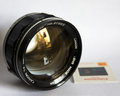 
last year for a family member. Sure wish it could have been adapted to an SLR, but the back focus distance was, of course, too short.
As regards very fast wide angle lenses, Gordon is right, there is a Canon 24/1.4 (as well as a 35/1.4) and both are fantastic lenses, and currently in production. As you go wider, it's more difficult and more expensive to produce a fast lens, because the front elements become very large and the curvatures become great. It's very hard to correct them for aberrations and hard to design them to maintain a flat field. |
|
|
|
02/07/2008 06:11:41 PM · #19 |
I have an old soligor 135mm f1.8. I think this is fast for a mild telephoto lens. It is for screw mount pentax, but I have a converter for canon mount. It is a great portrait lens.
Message edited by author 2008-02-07 19:24:18. |
|
Home -
Challenges -
Community -
League -
Photos -
Cameras -
Lenses -
Learn -
Help -
Terms of Use -
Privacy -
Top ^
DPChallenge, and website content and design, Copyright © 2001-2025 Challenging Technologies, LLC.
All digital photo copyrights belong to the photographers and may not be used without permission.
Current Server Time: 12/28/2025 10:28:07 PM EST.