| Author | Thread |
|
|
03/15/2007 10:29:46 AM · #1 |
So the bigger sensor and few fps faster wasn't that exciting, but this is ridiculous.
IdIII at ISO3200
here
Shot by AP photographer Mark Terrill
Message edited by author 2007-03-15 10:30:42. |
|
|
|
03/15/2007 10:31:16 AM · #2 |
| I don't get it - what is ridiculous? |
|
|
|
03/15/2007 10:36:05 AM · #3 |
| thats pretty awesome. Such low noise for such a high ISO |
|
|
|
03/15/2007 10:37:16 AM · #4 |
| Yep, that is some squeaky-clean ISO 3200. |
|
|
|
03/15/2007 11:04:32 AM · #5 |
| Certainly makes one stop and appreciate the fine detail in the image even down to areas such as under the eyebrows. The dynamic range is pretty good too. Makes me wonder how long it will be before some minor changes are made to the 5D. I doubt that the changes will be big - but there might be some worthwhile fine tuning.... that would tempt me. Meantime, I am at least at 30,000 clicks on the XT and wonder which will come first, the demise of my machine or the fine tuning... |
|
|
|
03/15/2007 11:25:08 AM · #6 |
Any noise reduction or did it come out of the camera like that? o_O
splidge
|
|
|
|
03/15/2007 11:26:31 AM · #7 |
Originally posted by splidge:
Any noise reduction or did it come out of the camera like that? o_O
splidge |
As far as I know that's how it falls out of the camera. There wouldn't be much point posting it as an example with noise reduction. It also doesn't have any of the usually obvious traces of NR software.
Here's the original source/ post
Message edited by author 2007-03-15 11:28:31. |
|
|
|
03/15/2007 11:32:55 AM · #8 |
| One thing to note is that even at high ISO, images tend to keep a fair amount of detail if the light is good. The same shot under poor light is another story entirely. |
|
|
|
03/15/2007 11:34:54 AM · #9 |
Originally posted by nikuser:
One thing to note is that even at high ISO, images tend to keep a fair amount of detail if the light is good. The same shot under poor light is another story entirely. |
Though properly exposed, it really doesn't matter much. and FWIW, this would be under pretty poor light - it is a night tennis match, shot at ISO3200, 1/1000s f2.8
That's quite dark.
Message edited by author 2007-03-15 11:36:23. |
|
|
|
03/15/2007 11:55:42 AM · #10 |
Sweet....*drools*...yes, that IS the camera I want.
(er....um...yeah....) |
|
|
|
03/15/2007 12:28:52 PM · #11 |
Originally posted by CEJ:
I don't get it - what is ridiculous? |
Compare another fine Canon camera, the 30D, known to be a good performer at high ISO values:
200 speed
3200 speed
Both the same shot, both shots 100% original size. |
|
|
|
03/15/2007 02:41:08 PM · #12 |
Originally posted by strangeghost:
Originally posted by CEJ:
I don't get it - what is ridiculous? |
Compare another fine Canon camera, the 30D, known to be a good performer at high ISO values:
200 speed
3200 speed
Both the same shot, both shots 100% original size. |
Yes, but I'd like to see a comparison of the 30D to the 1DMKIII. The statements lead one to believe that the latter has significantly less noise than even the 20D/30D.
Which would be extremely impressive! |
|
|
|
03/15/2007 02:44:53 PM · #13 |
Originally posted by theSaj:
Yes, but I'd like to see a comparison of the 30D to the 1DMKIII. The statements lead one to believe that the latter has significantly less noise than even the 20D/30D.
Which would be extremely impressive! |
You can see that in the pictures shown. The 1dIII is significantly better than the 30D. ISO 3200 on the 1dIII is 'native' while on the 30D it is a software tweak, which kills the dynamic range - much like on the 1dII.
The 1dIII will pull the same software trick to shoot at ISO6400 |
|
|
|
03/15/2007 02:48:39 PM · #14 |
Originally posted by theSaj:
Yes, but I'd like to see a comparison of the 30D to the 1DMKIII. The statements lead one to believe that the latter has significantly less noise than even the 20D/30D.
Which would be extremely impressive! |
My post was based on the assumption that the MkIII would be a better performer than the 30D, but of course I don't know this for sure. A direct comparision would definitely be a good thing. If anybody wants to send me a MkIII, I'll do that comparision and get the camera right back out to the owner within a few months. ;-) |
|
|
|
03/15/2007 04:00:49 PM · #15 |
Originally posted by strangeghost:
Originally posted by theSaj:
Yes, but I'd like to see a comparison of the 30D to the 1DMKIII. The statements lead one to believe that the latter has significantly less noise than even the 20D/30D.
Which would be extremely impressive! |
My post was based on the assumption that the MkIII would be a better performer than the 30D, but of course I don't know this for sure. A direct comparision would definitely be a good thing. If anybody wants to send me a MkIII, I'll do that comparision and get the camera right back out to the owner within a few months. ;-) |
One would assume the noise would be better on the mKIII given the somewhat larger sensor size for the same amount of pixels.
|
|
|
|
03/15/2007 04:12:04 PM · #16 |
| That shot is SIGNIFCANTLY better than ISO 1600 (or even 800) on the Rebel XT. This camera will be far and away my biggest camera purchase (heck, my biggest purchase that I haven't been able to live or drive in :o)), but it will be completely worth it. I just hope it won't be even higher than $4k! |
|
|
|
03/15/2007 04:22:52 PM · #17 |
Originally posted by DrAchoo:
One would assume the noise would be better on the mKIII given the somewhat larger sensor size for the same amount of pixels. |
Yes, for the most part, but improved electronics (lower-noise circuitry) also helps, and also likely improved detection of the photons that actually hit the each pixel.
The Mark III has the same pixel size as the Mark II, which is bigger than that on the 30D or XTI, and smaller than the pixel size on the IIN or 5D.
Camera; pixel size; pixel area
Mark III ; 7.2 x 7.2 micron ; 51.84 square microns
Mark IIN ; 8.2 x 8.2 micron ; 67.24 square microns (or 29% more area per pixel than Mark III)
1DS Mark II ; 7.2 x 7.2 micron ; 51.84 square microns
5D ; 8.2 x 8.2 micron ; 67.24 square microns
30D ; 6.4 x 6.4 micron ; 40.96 square microns
XTi ; 5.7 x 5.7 micron ; 32.49 square microns
(sorry about the formatting... can't figure out a better way to do tables in the forums)
So each pixel on the Mark III has 26.6% more area than the pixels on a 30D, but only 77.1% of the area that the pixels on a Mark IIN or a 5D have. So while the Mark III pixels are capturing more light than the 30D and XTi, the improvements in noise must also mean there is either improved sensing of the photons that hit that pixel and/or decreased noise in the circuitry that counts the photons. |
|
|
|
03/15/2007 04:36:44 PM · #18 |
Originally posted by asimchoudhri:
So each pixel on the Mark III has 26.6% more area than the pixels on a 30D, but only 77.1% of the area that the pixels on a Mark IIN or a 5D have. So while the Mark III pixels are capturing more light than the 30D and XTi, the improvements in noise must also mean there is either improved sensing of the photons that hit that pixel and/or decreased noise in the circuitry that counts the photons. |
I saw an article on this regarding the MKIII. Essentially, from what I gathered is that they shrunk the space between the receptors. And that in part is what has allowed both the improved noise quality and the higher tonal quality.
|
|
|
|
03/15/2007 04:45:40 PM · #19 |
Here it is:
//www.imaging-resource.com/PRODS/E1DMK3/E1DMK3A.HTM
Scroll almost to the bottom and you'll see an explanation along with diagrams and drawings.
Essentially, they shrunk the circuits (think Intel Processors when they shrink the die size).
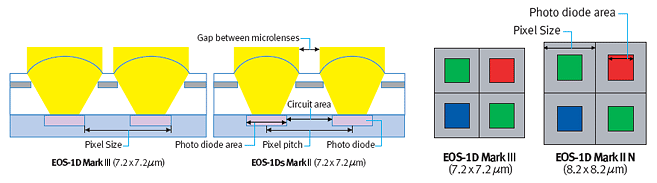
Message edited by author 2007-03-15 16:46:07. |
|
|
|
03/15/2007 04:50:49 PM · #20 |
Originally posted by theSaj:
Here it is:
Essentially, they shrunk the circuits (think Intel Processors when they shrink the die size).
|
Though that's precisely what they didn't do in this case. The circuits are the same size - which is the real advantage for this sensor. The photosites are the same size, even though there are more in the same area. What was changed was the overall pixel pitch. Meaning more active circuit area within the same sensor size.
The general march of Moore's law doesn't help camera sensors much, which are tied to a much less flexible real physical law, concerned with collector area. What happened in this case is that the layout and routing around the active photosites was improved, letting the same physical sized sensors be packed more densely, avoiding the usual penalty of squeezing more pixels in to less space.
There's even more fun packaging technology in the pipe, where you can effectively make a 100% coverage photosensor, by ion implanting the connections through the backside of the wafer. The trick is that half way through the fab process, the chip has to be sliced in half and flipped backwards, which is a little bit tricky to line up correctly for the subsequent phases, given the sensor size. Still pretty experimental but has a lot of potential to give much higher quality in the same physical sensor area.
Message edited by author 2007-03-15 16:54:07. |
|
|
|
03/16/2007 08:46:29 AM · #21 |
| Good Lord, I just wanna take purdy pictures! This here science stuff is hurtin' my noggin! :o) |
|
|
|
03/16/2007 03:26:55 PM · #22 |
What I've heard is that much of the noise is inducted from surrounding circuitry. So as smaller processes become commercially viable, the connecting paths within the silicon can become thinner, the transistors smaller, etc, leaving more room for the photosites or for isolation between active elements and photosites.
The evolution of CMOS to smaller and smaller processes helps improve sensors. The larger and larger wafers and chips help make sensors more affordable (in part because volume brings the price down) more area for transistors, and better process quality make higher-res ADCs available. and so on.
On the other hand, the size of a sensor is more-or-less fixed (APS-C, 1.3x, FF, ...) and so the price of a sensor will not fall as fast as a memory chip.
What I wish is that Canon would just keep the same number of megapixels and give us higher ISO. Would the 1DIII give us ISO 6400 native and 128,000 expanded if it was 8MP instead of 10MP? |
|
Home -
Challenges -
Community -
League -
Photos -
Cameras -
Lenses -
Learn -
Help -
Terms of Use -
Privacy -
Top ^
DPChallenge, and website content and design, Copyright © 2001-2026 Challenging Technologies, LLC.
All digital photo copyrights belong to the photographers and may not be used without permission.
Current Server Time: 01/02/2026 03:51:14 AM EST.