| Author | Thread |
|
|
01/25/2026 07:52:26 PM · #1 |
The results of the 'Square Crop Vll' challenge have been 'recalculated', due to the disqualification of the former 1st-place finisher,
We review each original file submitted for validation to confirm that it has not been modified and that it was captured within the challenge date window. This verification relies on standard EXIF metadata that our tools can interpret consistently.
In this case, the image was captured using a telescope and the available metadata does not allow us to reliably confirm those requirements using our current process. To ensure the same standards are applied uniformly to all entries, we are unfortunately unable to validate this submission and must disqualify it.
Congrats to our new 5th place honorable mention!
|
|
|
|
01/27/2026 09:19:26 AM · #2 |
Congratulations, markwiley on the blue! And I wish you had a longer front page exposure!
Just a quick clarification about what qualifies as a “RAW” file. My understanding is that camera-native RAW formats include, for example:
Canon: .CRW, .CR2, .CR3 (latest)
Nikon: .NEF, .NRW
Sony: .ARW, .SRF, .SR2
Fujifilm: .RAF
Olympus / OM System: .ORF
Panasonic / Lumix: .RW2
Pentax / Ricoh: .PEF, .DNG
Hasselblad: .3FR, .FFF
Phase One: .IIQ
Leica: .DNG, .RWL
Epson: .ERF
Mamiya: .MEF
Leaf: .MOS
Kodak: .DCR, .K25, .KDC
Generic/Universal: .DNG
I also looked up on the filetype .fits and it says: "a .fits (Flexible Image Transport System) file is a type of raw data file, often considered a "Super RAW" in astrophotography, as it stores the direct, unprocessed data from a camera sensor. Unlike standard image files, FITS files contain high bit-depth (8 to 64-bit) data and detailed metadata (camera temperature, exposure, etc.), requiring specialized, non-standard imaging software to open and process.
Could someone please clarify what the disqualification was based on..was it because the file was .FITS (not an accepted RAW format for this competition), or specifically because of concerns about editability/processing?
Thank you for clarifying. |
|
|
|
01/27/2026 10:56:09 AM · #3 |
That’s a fair question, and thank you for laying out the distinction so clearly.
To clarify: the disqualification was not because the file was a .FITS file, nor because we consider it “not RAW.” We understand that FITS files are widely used in astrophotography and contain sensor-level data along with extensive metadata.
The issue was purely one of verification. We must be able to confirm—using the standard tools and processes we apply uniformly to all entries—that:
1. the submitted original is unmodified, and
2. the image was captured within the challenge date window.
In this case, although metadata exists, the information available through our current EXIF-reading tools was inconclusive for reliably confirming those requirements. Because we have to apply the same validation standards consistently across all entries and file types, we were unable to validate the submission.
This is not a judgment about the photographer’s intent or the legitimacy of FITS files in general—only a limitation of our current validation process. We did try the photographer's suggested FITS viewer in addition to our standard EXIF reading programs but even that did not give us the data we needed. I don't know if other FITS files would have the same problem; I'm new enough on Site Council that I've never encountered one before.
Hope that clarifies things. |
|
|
|
01/27/2026 12:25:41 PM · #4 |
Thank you for your response,  MaryO. MaryO.
I’m not very knowledgeable about this aspect. I honestly thought we just needed to right-click the image and read the details manually. I didn’t even know EXIF tools existed for verification, so I really appreciate your informative explanation.
I’m torn.. I'm still sad for the previous blue-ribbon holder but don't want to hold it against the new blue-ribbon holder. Maybe in the future there will be a more advanced validation method for FITS so you can access the data you need. That said, I also understand the importance of safeguarding entries and protecting the integrity and spirit of the challenge.
Yes, you did clarify this. I feel more enlightened about the general scheme of things and principles. |
|
|
|
01/27/2026 02:58:47 PM · #5 |
FITS are used for scientific purposes because of their extensive and accurate meta data, in addition to the advantages the format brings when processing the images. I have done scientific observations in collaboration with ESA and the FITS meta data is crucial to ensure accurate measurements.
I provided a viewer as an example, but there are a plethora of tools available to view the meta data. The one I sent was just convenient because it's quick and comprehensive.
What more information could possibly be required than what is in the FITS header? It seems like it's the capture date. There it is: DATE_OBS: / UTC start date of observation. The meta data even includes the celestial position (RA and Dec), so you can verify that it is indeed NGC 2070, as well as the Alt/Az coordinates so that you can verify the time - it's only going to be at that position at a very specific time. I believe the GPS coordinates should also be in there. It's very comprehensive.
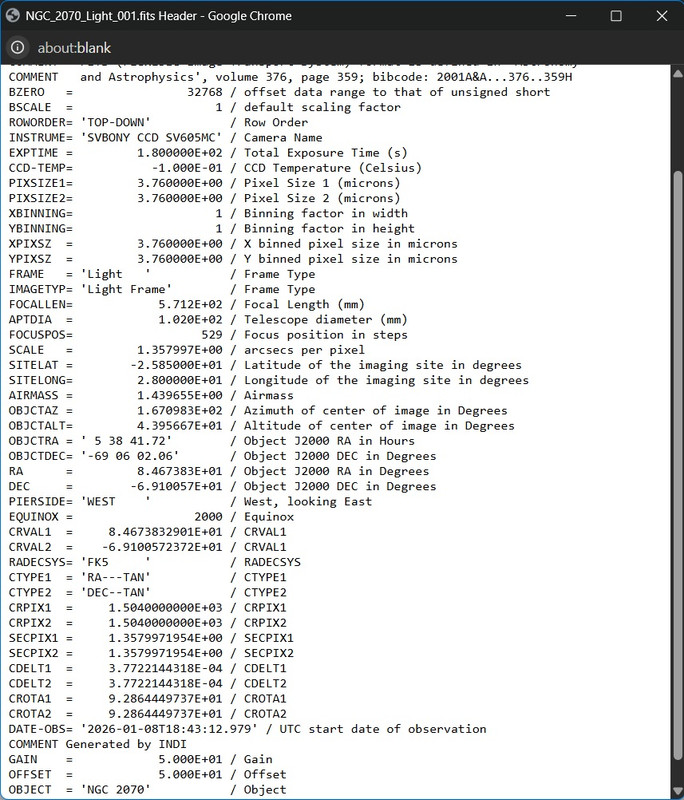
Either way, this image came out so much better than I had hoped, and I am very happy to have shared it with a few people. I usually enjoy shooting small planetary nebulae and searching for images of these larger nebulae, but I haven't seen the Tarantula nebula quite like how I've captured it. It shall adorn a small part of a wall in my house soon. |
|
|
|
01/27/2026 03:13:50 PM · #6 |
It doesn't have the standard EXIF Modify date, which needs to be the same as the Create date so we can verify it's an original. We did try some other tools but nothing gave us both dates.
It's a gorgeous image. We really did try to find a way to validate it. |
|
|
|
01/27/2026 04:11:27 PM · #7 |
Create date is the DATE-OBS field - as the comment states, the UTC start date of the observation. Since it is a 180s exposure, the start date indicates when the sensor began capturing photons. The Modify date would appear in the DATE field, not present as the file is unmodified, as is the requirement.
This is what it would look like (example taken from one of my stacks - a modified FITS file after stacking in SiriL):
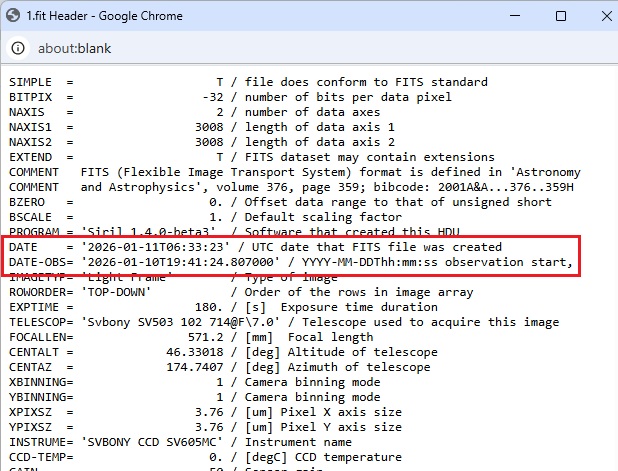
What this means is that FITS is not a valid format (unless I modify the images, which is far beyond worth it).
FITS files are not accessed in the same way as other image formats because they store the data differently, and can be read more efficiently for stacking purposes. |
|
|
|
01/28/2026 07:13:00 AM · #8 |
I watch too many documentaries... this can be solved by a Forensic Image Analyst or a Digital Photography Forensic Expert. These experts specialize in authenticating digital images, detecting manipulation and analyzing metadata to prove the integrity of a photograph (for legal proceedings).
It's gonna be a Pyrrhic victory though |
|
Home -
Challenges -
Community -
League -
Photos -
Cameras -
Lenses -
Learn -
Help -
Terms of Use -
Privacy -
Top ^
DPChallenge, and website content and design, Copyright © 2001-2026 Challenging Technologies, LLC.
All digital photo copyrights belong to the photographers and may not be used without permission.
Current Server Time: 09/07/2026 05:38:17 PM EDT.