| Author | Thread |
|
|
02/11/2009 12:30:14 PM · #1 |
I just bought a second-hand polarizer for my Sigma 18-200mm lens. It was only after I got it home that I remembered that polarizers come in both circular and linear. It turns out mine is linear. As I bought it at an auction, I am unable to return it. Will I be able to make any use of it, or have I just thrown my money away?
|
|
|
|
02/11/2009 12:33:46 PM · #2 |
it will still work
you may have to adjust your exposure
|
|
|
|
02/11/2009 12:34:39 PM · #3 |
| sure, you can still use it ... especially for landscapes/seascapes ... might come in very handy for the current 'tilted horizon' challenge ;) |
|
|
|
02/11/2009 12:36:59 PM · #4 |
Originally posted by pamelasue:
sure, you can still use it ... especially for landscapes/seascapes ... might come in very handy for the current 'tilted horizon' challenge ;) |
Subject is irrelevant. To the degree that it doesn't work, it will be because at certain angles of rotation in *may* interfere with metering and/or autofocus. Most of the time it will work OK though.
R.
|
|
|
|
02/11/2009 12:37:37 PM · #5 |
Originally posted by ralph:
it will still work
you may have to adjust your exposure |
Adjust exposure how?
|
|
|
|
02/11/2009 12:39:19 PM · #6 |
| the great thing about digital- go play and see what happens. its not going to cost you anything. blow a few exposures, and experiment! |
|
|
|
02/11/2009 12:55:28 PM · #7 |
Originally posted by GinaRothfels:
Originally posted by ralph:
it will still work
you may have to adjust your exposure |
Adjust exposure how? |
It will probably overexpose at certain angles. You can catch it by checking your images after you shoot 'em in the LCD screen. Enable the histogram, if the "hill" is pushed from the middle towards the right, you are probably overexposed, though this may not be true with a predominately light-colored subject.
R.
|
|
|
|
02/11/2009 01:00:57 PM · #8 |
Thanks Robert. I thought when I posted this that you were probably the best person to answer my questions.
|
|
|
|
02/11/2009 01:03:51 PM · #9 |
Originally posted by GinaRothfels:
Originally posted by ralph:
it will still work
you may have to adjust your exposure |
Adjust exposure how? |
If the filter came with documentation then it has a filter factor. Polarizers can have adjustable filter factor so you might need to bracket. IF a filter has a factor of +2 for example, add two stops of exposure to the meter reading without a filter. |
|
|
|
02/11/2009 01:12:00 PM · #10 |
Originally posted by hyperfocal:
If the filter came with documentation then it has a filter factor. Polarizers can have adjustable filter factor so you might need to bracket. IF a filter has a factor of +2 for example, add two stops of exposure to the meter reading without a filter. |
This is not the issue. Filter factor is irrelevant. Look at it this way: with a CIRCULAR polarizer you never need to think about filter factor, what the meter reads is the actual light passing through the lens to the sensor.
But with a linear polarizer, at certain angles of polarization the filter may cause the meter to read less light than is actually falling on the sensor. In just the same way that you can stack two linear polarizers and counter-rotate them so that NO light (or very little) gets through, so is it possible that at certain angles the meter and the polarizer establish some degree of cancelling-out of light.
End result: overexposure.
I have been told that this is MUCH less of a problem with modern meters, but I have no first-hand evidence of this. It was a DEFINITE problem with more primitive TTL meters in the film days. I'm talking Nikon F2 days, LOL...
R.
|
|
|
|
02/11/2009 01:38:17 PM · #11 |
I think you will find that the polarization that looks good through your lens (when you twist the linear polarizer ring) will cause deep polarization in the central portion of the frame with softer to almost nil polarization far right and far left in your frame.
That is from my personal experience. But, as mentioned, it will not cost you anything to experiment ... no film or print developing expense.
|
|
|
|
02/11/2009 01:45:42 PM · #12 |
there is a small chance you will have auto focus issues
this looks like a interesting page describing the effects |
|
|
|
02/11/2009 01:53:50 PM · #13 |
I don't believe you will see any large errors in metering with the linear polarizer. You very well may see an affect on AF, in fact AF may not work at all in some or all situations. For landscape work, that's not really much of an issue, IMO.
A bit of background information: a "circular" polarizer is just a linear polarizer with the addition of a "quarter-wave plate" to the back. The front portion of the polarizer passes light polarized in one direction (let's say horizontal) at nearly 100%, but vertically polarized light is not passed. Therefore, light that has passed through the polarizer is now predominantly polarized in the horizontal direction. The quarter-wave plate simply takes 50% of that light and rotates the polarization 90 degrees, so that the light exiting the filter has both horizontal and vertical polarizations again. This enables AF systems that depend on the presence of both polarizations to function. That's really the only difference. |
|
|
|
02/11/2009 01:55:11 PM · #14 |
Originally posted by kirbic:
I don't believe you will see any large errors in metering with the linear polarizer. You very well may see an affect on AF, in fact AF may not work at all in some or all situations. For landscape work, that's not really much of an issue, IMO.
A bit of background information: a "circular" polarizer is just a linear polarizer with the addition of a "quarter-wave plate" to the back. The front portion of the polarizer passes light polarized in one direction (let's say horizontal) at nearly 100%, but vertically polarized light is not passed. Therefore, light that has passed through the polarizer is now predominantly polarized in the horizontal direction. The quarter-wave plate simply takes 50% of that light and rotates the polarization 90 degrees, so that the light exiting the filter has both horizontal and vertical polarizations again. This enables AF systems that depend on the presence of both polarizations to function. That's really the only difference. |
Thanx, Fritz; I knew it made sense to PM you and call you in on this one :-)
R.
|
|
|
|
02/11/2009 06:20:28 PM · #15 |
Thanks for all the information. I will have to experiment with it and see what results I get - if we ever have sunny weather again! This is supposed to be summer, but the last couple of weeks there's been so much rain it's not even funny any more.
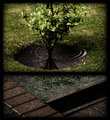
This was our garden just after a particularly heavy downpor last week. We're still lucky, there has been quite a bit of flooding in some of the surrounding areas. As always seems to be the case, the poor are the worst hit.
|
|
|
|
02/11/2009 06:31:43 PM · #16 |
Originally posted by GinaRothfels:
Thanks for all the information. I will have to experiment with it and see what results I get - if we ever have sunny weather again! This is supposed to be summer, but the last couple of weeks there's been so much rain it's not even funny any more.
This was our garden just after a particularly heavy downpor last week. We're still lucky, there has been quite a bit of flooding in some of the surrounding areas. As always seems to be the case, the poor are the worst hit. |
That's a way cool image; looks almost like a diptych, but on examination it looks as if the horizontal "bar" is actually a bias cut on the lawn trimming?
R.
|
|
|
|
02/11/2009 06:39:55 PM · #17 |
Originally posted by Bear_Music:
Originally posted by GinaRothfels:
Thanks for all the information. I will have to experiment with it and see what results I get - if we ever have sunny weather again! This is supposed to be summer, but the last couple of weeks there's been so much rain it's not even funny any more.
This was our garden just after a particularly heavy downpor last week. We're still lucky, there has been quite a bit of flooding in some of the surrounding areas. As always seems to be the case, the poor are the worst hit. |
That's a way cool image; looks almost like a diptych, but on examination it looks as if the horizontal "bar" is actually a bias cut on the lawn trimming?
R. |
Thanks for the compliment. Actually it is a diptych - put together for the diptych side challenge.
|
|
|
|
02/11/2009 07:33:17 PM · #18 |
I agree with kirbic. The linear polarizer is still plenty useful, but you may have trouble with the AF on your camera. If you get a circular polarizer, don't throw this away because you may be able to have fun with some truly long daytime exposures. The linear polarizer, if placed over the circular, should slowly stop light from entering as you turn it. At the maximum it may not let any light through. So you can control the amount of light that gets in and allow you, theoretically, to do 30 second, 2 minute, 5 minute exposures during the day which could be cool for some stuff. I've thought about trying to find a linear polarizer for this exact reason.
Check out this thread from 2006:
Using two linear polarizers? |
|
|
|
02/11/2009 08:03:14 PM · #19 |
Originally posted by DrAchoo:
I agree with kirbic. The linear polarizer is still plenty useful, but you may have trouble with the AF on your camera. If you get a circular polarizer, don't throw this away because you may be able to have fun with some truly long daytime exposures. The linear polarizer, if placed over the circular, should slowly stop light from entering as you turn it. At the maximum it may not let any light through. So you can control the amount of light that gets in and allow you, theoretically, to do 30 second, 2 minute, 5 minute exposures during the day which could be cool for some stuff. I've thought about trying to find a linear polarizer for this exact reason.
Check out this thread from 2006:
Using two linear polarizers? |
That sounds really interesting - worth a try sometime.
I've actually got an old red/green polarizer lying around somewhere that I haven't used for ages. When I still used film I occasionally used it in combination with a normal (circular) polarizer - producing images that were totally black & red/green. It might be worth trying the two together for some black & white shots. With a different lens of course, because this is the only polarizer I've got that is large enough to go on the Sigma 18-200mm.
|
|
Home -
Challenges -
Community -
League -
Photos -
Cameras -
Lenses -
Learn -
Help -
Terms of Use -
Privacy -
Top ^
DPChallenge, and website content and design, Copyright © 2001-2026 Challenging Technologies, LLC.
All digital photo copyrights belong to the photographers and may not be used without permission.
Current Server Time: 05/11/2026 07:56:49 AM EDT.