| Author | Thread |
|
|
04/30/2008 03:00:10 PM · #1 |
I am new to SLR lenses. I've learned a lot so far, such as some lenses have internal focusing which is usually quiet and fast and allows manual override, while some lenses don't and require a rear focus motor in the camera. I also know that some lenses are manual focus all the time. I know that some lenses have an aperture ring, and some do not. Those being type D and type G.
What I do not understand is, how exactly does aperture function when using a non-G type lens. A lens with a manual aperture ring. Can the camera still control the aperture on such a lens or is it manual only? If it cannot control the aperture, does that mean in effect that the camera is always in Aperture Priority mode when such a lens is used?
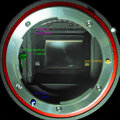
I made an image of what I believe to be true of the D300 lens mount. The one item in question is the red ring with a tab sticking out. I know this has something to do with aperture or metering however I am unsure if it explains my question or not.
Thanks for any insight you can provide, cheers!
|
|
|
|
04/30/2008 03:06:06 PM · #2 |
for all 'modern' non 'G' lenses the camera operates the aperture
as in you adjust the camera (not the lens) to either a fixed (A + M mode) aperture
or variable aperture (P & S modes)
older lenses may require aperture adjustment
|
|
|
|
04/30/2008 04:00:03 PM · #3 |
Hmm, ok, but what does the outside ring do? I know without a lens attached moving it changes the aperture on the LCD panel from 0 to 8, it doesn't seem to go beyond that.
Thanks again!
|
|
|
|
04/30/2008 04:38:51 PM · #4 |
| These peopleshould be able to answer your question. |
|
|
|
04/30/2008 04:51:58 PM · #5 |
Trying to get rid of me that easily eh? Don't want me asking too many questions here, eh?
Hehe, I will give them a shot :)
|
|
|
|
04/30/2008 05:00:37 PM · #6 |
| All the types of lenses you spoke of can be used in either man or auto. With the D series and some G's you have to lock the apeture ring with the little tab with the orange mark. Now if the lens is an older lens it won't have any connectors for the cpu in the camera and you will have to manually operate the apeture and the focusing. |
|
|
|
04/30/2008 05:10:10 PM · #7 |
I guess my main question is, are there lenses which have a manual aperture ring which can be adjusted by the camera? And if so, how do I tell those from lenses which are only manual?
:) |
|
|
|
04/30/2008 05:17:20 PM · #8 |
Almost all modern Nikon lens (post 1973) can be aperture controlled by the D300. You manual will have an exact list. You set the aperture to the smallest size/highest value and the camera does the rest. That's the only way they will work. If you set the aperture to any value less than max the camera will out put an "ERR" warning.
Edit: now that I think about it my D200 outputs a "FEE" warning if
memory doesn't fail me. I'm too lazy to turn the camera on. :)
Message edited by author 2008-04-30 17:20:32. |
|
|
|
04/30/2008 05:19:42 PM · #9 |
| Very interesting, I have been seeing lenses with an aperture ring and ignoring them because I thought I would lose shutter priority mode. If I understand this correctly I am very happy. :) |
|
|
|
04/30/2008 05:22:03 PM · #10 |
Originally posted by togtog:
Very interesting, I have been seeing lenses with an aperture ring and ignoring them because I thought I would lose shutter priority mode. If I understand this correctly I am very happy. :) |
Hmmmm, not sure about this. I would advise you to read your manual.
Advice you get here is worth exactly what you pay for it. :) |
|
|
|
04/30/2008 05:27:26 PM · #11 |
Alright, I got curious. How this overcame my natural laziness I have no idea. I placed my 85mm F1.8 Nikkor with aperture ring on my D200. I set the mode to shutter priority. As I panned the camera around the room the aperture automatically changed according to available light. So it looks like you can start looking at lenses with aperture rings again. Shutter priority with these lenses works fine. :)
Message edited by author 2008-04-30 17:27:59. |
|
|
|
04/30/2008 06:33:47 PM · #12 |
| Again, if you are to use the auto app in the camera the orange tab HAS to be locked. It will not work otherwise. When doing this your app on the lens will read F/22, however when you view through the eyepiece, it will change accordingly whether you are in app priority or shutter priority or full auto. When you change to manual you will have to unlock the orage tab and adjust your app manually. This system has been around since the first auto SLR Nikon has ever made, and it works very well. This is one reason Nikon owners are so loyal, we can go and get a lens made in the 70's and it will still work on a new camera. Canon changes their lens mount when the EOS line came out in the late 80's, many Canon users switched just for this reason. And now many people who have old Canon's are pissed because the new DSLR they just bought won't accept theiir lenses. |
|
|
|
10/11/2008 12:33:41 PM · #13 |
I am clearing old threads up and noticed I never replied to this one, I am very sorry.
I want to thank everyone for their advice on this matter, it is very clear now and has opened up a great deal of options lens wise. Once again DPC rocks!
|
|
|
|
10/11/2008 01:46:50 PM · #14 |
While you are here, be sure that you do not try to mount the very old all manual "Non Ai" lenses on your D300. With those, the back of the aperture ring is smooth all the way around, and it will bend the little lever that sticks out of the body on the lower shutter button side of the lens mount. The "Ai" Ai-s" or "Ai'd" lenses will work fine all manual. The Ai, and D lenses have notches in the back of the aperture ring, and a tab sticking out of the aperture ring pushes the little lever down to tell the camera that the lens is at max aperture.
Your camera manual should have a listing of what lenses will not work with your D300. Some, but not very many, older Nikkor lenses also protrude into the camera body too far, and will interfere with the operation of the mirror.
ETA
Looking at your photo above, I don't see the little "full aperture" lever. With the Nikon lens system, except for the G lenses, the lens stays at full aperture until you trigger the shutter, then the aperture linkage moves the lever on the back of the lens to bring the aperture down to the setting you are using via the camera controls. With the D lenses, you can see how that operates by moving the little lever sticking out of the back of the lens with the aperture ring set at differing apertures.
Message edited by author 2008-10-11 13:55:22.
|
|
Home -
Challenges -
Community -
League -
Photos -
Cameras -
Lenses -
Learn -
Help -
Terms of Use -
Privacy -
Top ^
DPChallenge, and website content and design, Copyright © 2001-2025 Challenging Technologies, LLC.
All digital photo copyrights belong to the photographers and may not be used without permission.
Current Server Time: 12/27/2025 09:48:16 AM EST.